Behold, as a wild ass in the desert, go I forth to my work,
or
Why David Lynch failed in adapting Dune, and why Denis Villeneuve might just succeed
(Note from 2022 Liam: the movie was okay. Take this paper with a grain of salt, please.)
(2019)
Having again read Frank Herbert’s seminal novel Dune this past summer at an important juncture in my life, I was inspired to watch the 1984 film adaptation. Scores of critical reviews of David Lynch’s adaptation – then costing Universal some $40 million – have since confirmed my and many others’ impression that the film was a bloated failure. Far from lessening my interest in the book, however, the film intrigued me – I found myself questioning what had led to the discrepancy between what I’d read and enjoyed so recently and what the critic Roger Ebert called “…an incomprehensible, ugly, unstructured, pointless excursion into the murkier realms of one of the most confusing screenplays of all time” (1984). Short of another op-ed about why David Lynch should be defenestrated for his work on the film – a opinion which I believe to be more unfair than not – this paper discusses why Lynch faltered. It asks why the novel, so wildly popular to a generation of readers, should prove such a daunting project to film. The question, of course, grew even more interesting to the film community when news broke that Denis Villeneuve had assumed control of the next adaptation of the novel. Everything Villeneuve has directed, I’ve loved. With him in the picture, my question changed from “where did Lynch mess up” to “why did Lynch falter, and how could Villeneuve manage to do Dune justice where Lynch could not?” By analyzing the source text, Lynch’s film, the wealth of commentary on the film that has sprung up since its release, and Villeneuve’s past work, I believe one can map a constellation of what it means to adapt Herbert’s novel – and the potential dangers of the same. Though the stylistic pitfalls of the 1984 film are the central tenets of this paper, I hope to also explain why I believe 2020’s Dune will prove a critical success. I will initially review the process of Lynch creating a film he did not have total control over, and how his artistic choices – and skill set – were maladapted to the project. I will describe those aspects of the film that did not work in some detail -- cinematography, art direction, editing, soundscape, lighting, and even casting -- and the related aspects of Villeneuve’s past work that absolutely confirm my opinion that he is perfectly suited for the job.
Dune takes place far in the cosmic future, and follows the young Paul Atreides as his house transitions from their water-rich, idyllic home world of Caladan to the desert planet Arrakis. Only on Arrakis – colloquially known as Dune – can the spice melange be found, a galactic fuel and currency that improves health and augments prescience. The Harkonnens, another galactic lineage who have a vested interest in the downfall of their rival house, plan on attacking the Atreides upon their arrival on Arrakis, whose spice harvesting operations the Harkonnens formerly owned. The combination of tension between the two houses, mercurial relations with the native Fremen people, the extreme water shortage, and the menacing sand-worms (gargantuan creatures in the deep desert that are attracted to sound and consume melange) set a very hostile stage for house Atreides. Soon after arriving they are set upon and all but extinguished. Shortly thereafter, the Harkonnens land on Arrakis and — by decree and with the military backing of the Emperor — begin to hunt the Atreides. Paul’s mentor figures are scattered or killed. He and his mother, Jessica, escape into a powerful sandstorm and ride its turbulence to safety deeper in the desert. They are found by a troupe of Fremen, the native populace of Dune, and are offered protection after proving their worth. Through a series of maneuvers made by the increasingly powerful and prescient Paul, the Fremen rise up against the Empire and the Harkonnens. The plot chronicles the young Atreides as he transforms into Mau’dib, the all-seeing leader of Fremen prophesy, expanding his consciousness through consuming the concentrated spice bile of the sand-worms.
Sharing the Hugo award with Roger Zelatny’s This Immortal in 1966, Frank Herbert’s Dune has since been hailed as one of the defining science-fiction classics of our time, going on to sell over 12 million copies (Stasio, 2000). Hollywood could not have ignored the potential of the novel, though it didn’t come quietly. Arthur P. Jacobs optioned the rights to a Dune film in 1971 before suffering a heart attack at age 51. Alejandro Jodorowsky, described as “a visionary” by Denis Villeneuve (Fandom, 2018) created and cast his own expansive version of Herbert’s universe with the help of an army of character-design artists and visual-effects wizards before a lack of funding forced dormancy on the film again. Many well-known special effects artists made their name in this process, including H.R. Giger, the mind behind the “…psycho-sexually arresting look of Alien” (Ellison, 599). Under the umbrella of a French consortium, Dino De Laurentiis purchased the rights to the film in 1976, hiring Ridley Scott in 1979 as the director. After Scott realized it would take a few years to bring Dune to fruition and his “…older brother Frank unexpectedly died of cancer while [he] was prepping the De Laurentiis picture” (Sammon, 112), he backed away from the project. “A viewing of The Elephant Man led the producers, [namely Rafaella, Dino’s daughter,] to approach Lynch [granting the young director] around $40 million, a massive amount at the time, making it one of the most expensive films ever made — also allowing him to develop the script, the very stumbling block that had caused previous attempts to falter. Lynch was to turn in eight drafts of a Dune script before he was happy” (Le Blanc and ODell, 45). Eventually, after months of filming with a crew of 1700 in the Mexican desert, the film was edited down from an initial four-hour rough cut to something closer to half that length (Murphy, 1996). Lynch has stated repeatedly in interviews since, with obvious measures heartbreak and disdain, that he wasn’t given final cut on the film, regretting signing up to “…make a film that [couldn’t] be the film [he wanted] to make” (DuneInfo, 2012). Unhappy with the film’s corrosion, Lynch sued to have his name expunged from its television version. His directing credit has generally been replaced by “Alan Smithee” since that time (Murphy, 1996).
After early screenings of Dune, word-of-mouth spread quickly — under doorways and over phone-calls — that the film was an unmitigated disaster. Notable film critic Harlan Ellison reports that Frank Price, chairman of MCA/ Universal Motion Picture Group at the time, declared “[the film] a dog. It’s gonna drop dead. We’re going to take a bath on it. Nobody will understand it!” (Ellison, 623). He said something of the sort publicly enough for a nebulous sense of dread to ripple out over the entire Universal lot as word of the $40 million-dollar failure spread. Before it had even really begun its press buildup, the film was branded high and low as faulty merchandise. “Of a sudden, Dune was not a film to be seen by the laity” (Ibid, 636). He writes of a screening in New York where one attendee sprang to their feet after the viewing and shouted “When are you going to stop making shit like this? When are you going to give us a picture we can play that will make some money? Are you trying to kill us?” (Ibid). Ellison was approached by USA Today to write up a review of the film; upon arriving at a screening on the 30th of November, 1984 he was barred from entry out of fear of a bad review by an apologetic bouncer (Ibid, 628). Twenty-four days after Ellison was forbidden to attend the screening of it, Dune was released worldwide (Duneinfo, 2012). Frank Herbert, interviewed at his home in Manhattan Beach after having seen an early screening of the film, said that “It begins as Dune begins, it ends as Dune ends and I hear my dialogue throughout. How much more could a writer want?” (Ellison, 626).
Of course, therein lies much of the problem; Lynch’s Dune collapsed under the weight of depicting the source-text too faithfully. Endeavoring to pay homage to all of Herbert’s universe, it exposed its audience to a confusing miasma of detail, a panorama of odd and discordant parts. Eventually, of course, large parts of the film were whittled away — the original cut ran well over four hours — to save through excision a venture many were then becoming unsure of. To work on screen, especially in a single film, the Herbert’s book had to be condensed considerably but retain its momentum and cohesiveness. It wasn’t, and as a result, the film feels dense without mass. As author Thomas Leitch states, “Three hundred page novels cannot be adapted to feature length films without a great deal of systematic elision and omission” (99). Dune called for a “…combination technician and administrator” (Foster Wallace); Lynch is as much the first as he isn’t the second. His prior film, Eraserhead, had been a tiny operation with a small and largely unpaid crew, whereas everything in Dune was filmed from four different angles (Murphy, 1996) and had a cast the size of “…a small Caribbean nation” (Foster Wallace). Perforce, Lynch ultimately proved unequal to the task — as Roger Ebert stated, “Dune look[ed] like a project that was seriously out of control from the start” (1984). While the physical challenge of making a $40 million-dollar film in the searing heat of the Mexican desert would have daunted any director, he also had to mediate between the film’s underwriters — obviously clamouring for a marketable film — and the novel’s length and complexity. With no room to breathe, the film’s audience never gets a real chance to lose themselves in a story that deserves it. As one critic puts it, “Standard tactics of adaptation — selecting some obligatory speeches, characters, scenes, and plotlines and dropping others, compressing or combining several characters or scenes into one; streamlining the narrative by eliminating digressive episodes; reworking dialogue so that it is either more epigrammatic or more severely functional — [were] clearly inadequate” (Harwood, 129) in the case of Lynch’s Dune.
Could another director have done better? “Standard tactics of adaptation” of the novel must contend with its superflux of alien place and character names. Kwisatz Haderach? Gom Jabbar? In other sagas, such as the Star Wars films, the strange place and character names and institutions of the universe are for the most part aesthetic and non-inhibiting, “…analogous to verbal art design; there to provide texture.” These same details in the novel are “…integral to the narrative” of Dune (Odell & Le Blanc, 47). The audience needs to know these names and their meaning; without them, the film lacks cohesion. A character will mention something once which won’t resurface, if at all, until later in the film. CHOAM (Combine Honnete Ober Advancer Mercantiles), a sort of economic super-power which controls all trade in the galaxy and a relatively important aspect of the novel, is brought up three times in passing only in its abbreviated form. Cervantes posits that “Plots in fiction should be wedded to the understanding of the reader” (442), but what is a close union in novel form unraveled quite spectacularly in Lynch’s adaption. If anything, his Dune simply tried to be something it didn’t have the time to be, though it is important to say that even if released as Lynch’s original unedited version it most probably still wouldn’t have paid proper homage to the central tenet of Herbert’s novel.
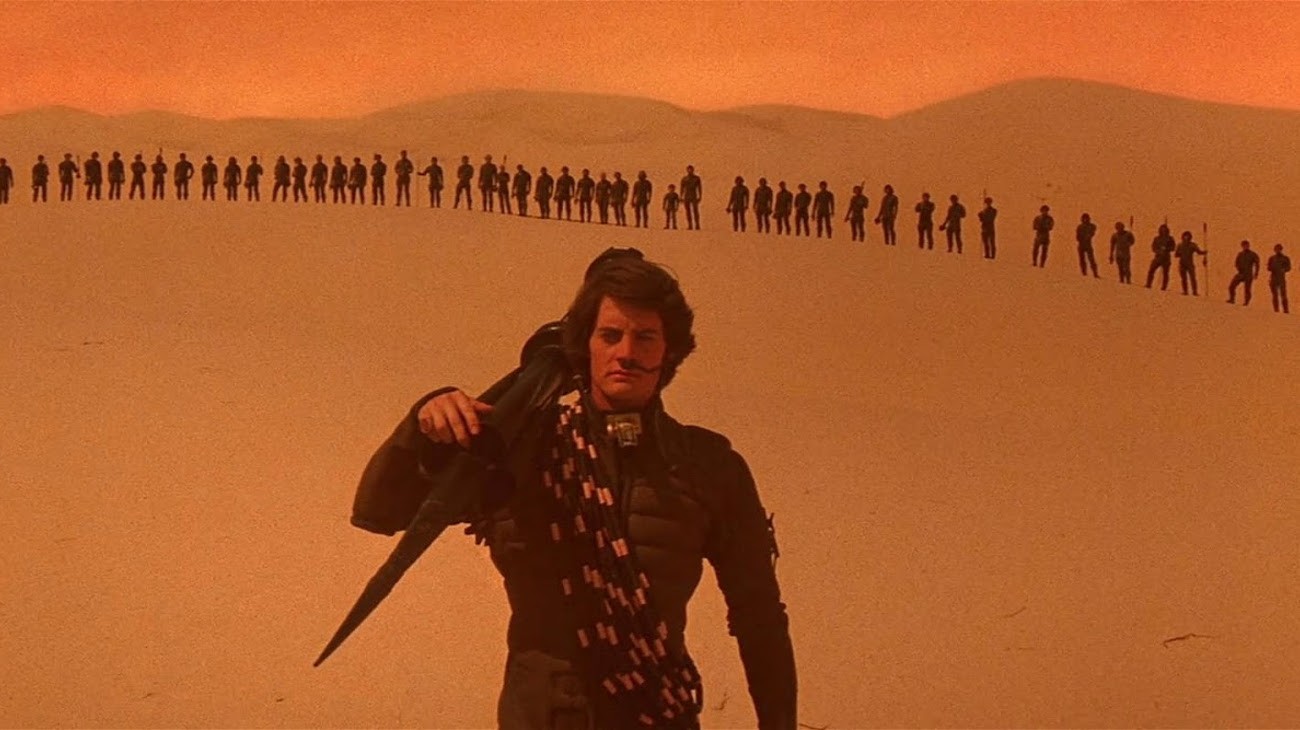
In truth, the beating heart of the book is the same thing that initially interested Herbert: science, desert ecology, and environmental systems. Frank Herbert travelled to the coastal town of Florence, Oregon in 1957 to study the dunes there (McNelly, 1969) and his son, Brian Herbert, explains that “[his] father emphasized a world view of living in harmony with nature [and] the dunes got him thinking more about man’s involvement in relation to it” (Hahn). In the mid 1950s, drifting sands were beginning to pose a threat to the railroads, highways, local water supplies, and vegetation of the area. In a coordinated agricultural rebuttal, the U.S. Federal Government planted legions of European beach grass along the coast between Florence and Coos Bay. Herbert took a small chartered plane over the dunes and witnessed from above the deliberate, fluid danger the sand posed. He wrote to his literary agent Lurton Blassingame that, left to it, the dunes could “swallow whole cities, lakes, rivers, [&] highways,” and how he saw that the government was beginning to “…control the flow of sand dunes” by sowing them with the grass (Herbert et. al, 264). He dedicated the next five years to studying the dunes. Despite doing so initially for an article about the area called “They Stopped the Moving Sands,” the amount of material proved too massive for easy synthesis, and the article fell to the wayside. But something had crystallized out of his sustained environmental studies — his time near Florence had impacted him greatly, and he was “…fascinated by sand dunes” (McNelly, 1969). They would form the nucleus of his 1965 novel, the European beach grass his protagonist. The discovery that Arrakis hosts an abundance of life attuned to its hardships mirrors the interest Herbert took in researching his “They Stopped The Moving Sands” article. The dedication at the beginning of Dune, “To the people whose labors go beyond ideas into the realm of ‘real materials’ — to the dry-land ecologists, wherever they may be, in whatever time they work, this effort at prediction is dedicated in humility and admiration” (Herbert, 3), speaks for itself. Liet Kynes, the Fremen leader upon Paul’s arrival on Arrakis, dreams in parallel with his people of a green future for their planet. His environmentally conscious point of view and scientific mind are diegetic expressions of Herbert, Kynes a meta-personification of the author himself. He saw his creation — the world of Arrakis — as an entity within the story exactly as important as any character. In the 1984 foreword for Heretics of Dune, Herbert writes that he intended “…to produce another view of a human-occupied planet as an energy machine. [Dune] was to penetrate the interlocked working of politics and economics” (Herbert, 2). All this to say that Lynch adapting Dune and siphoning importance away from this aspect of the story — man’s relation to the environment — robbed the adaptation of its essence, its actual thematic marrow. Lynch too rarely depicted, much less flattered the landscapes and topographies of the Herbert’s alien worlds, casting them more as an annoyance, their beauty second only to their harshness (fig. 1), whereas Herbert saw this harshness and beauty as two sides of the same coin. To succeed, a film adaptation of Dune must take the novel’s environmental theme more seriously.
Fig. 1: The uninspiring desert-scape of Lynch’s Arrakis in Dune, (David Lynch, 1984)
On the topic of viewing Blade Runner for the first time as a fourteen-year-old, Denis Villeneuve says “It was something [he] was deeply looking for: someone who would take sci-fi seriously. In literature, it’s a serious genre […] Isaac Asimov, Frank Herbert, Arthur C. Clarke. Those artists [took] sci-fi seriously” (Mottram, 26). Thirty-seven years later and Villeneuve has been signed on to direct the next adaptation of Dune. After helming a string of hugely successful movies (his most recent, Bladerunner: 2049, earning $259.2 million) Villeneuve has proven his directorial merit. It bodes well that in many ways the narrative of Dune resembles Villeneuve’s 2016 Arrival. Both depict a sudden changing of their protagonist’s world, resulting in a spiritual awakening that is of cosmic importance. Both feature what we would call aliens. Both are more than plot-driven escapism, aspiring instead to the cerebral. Denis Villeneuve himself said a few years before Dune was his to direct that “…it’s always difficult to find original and strong material that’s not just about weaponry” (Martin). Of course, the more cerebral nature of the story makes for some difficulty in narrative exposition, but Villeneuve demonstrated in Arrival that he can do extra-terrestrial and philosophical. Nevertheless, adapting Dune for a 2020 audience raises discrete challenges — ones not confronted by Lynch. For one thing, aspects of the book will seem dated today if not treated with a certain grace, such as the depraved tendencies of Baron Harkonnen, the white-savior narrative of Paul guiding the Fremen, and overwhelming male-centricity of the novel. They now seem retrograde in Lynch’s film. However, Villeneuve will have access to something Lynch did not: the benefit of referencing Lynch’s film. “Many filmmakers make contributions so definitive to the films on which they collaborate that their hand is instantly recognizable” (Leitch, 237); perhaps Lynch’s contribution to the canon of Dune was that of a pathfinder, even a martyr. Though he had access to a wealth of resources, to be fair to Mr. Lynch, “…not all adaptations are created equal” (Leitch, 93), and with less experience on large-scale shoots and a massive amount of material to convey to the audience, Lynch’s adaptation began at a serious disadvantage. The size of the undertaking was always going to be at odds with his insular directorial style, wherein his creative control is paramount. Lynch’s dedication to his own vision is “…[indicative of either] raging egotism or passionate dedication or a childlike desire to run the sandbox, or all three” (Foster Wallace). The same thing that made the smaller-scale Eraserhead work did not scale up accordingly for Dune. It would of course be impossible to have directly overseen every aspect of a shoot the size of Dune’s. Earlier versions of the script showed that Lynch had epic plans for the width and breadth of his film, but each successive version of the script reads as more streamlined and less voluminous (Lynch, 1982). As author and playwright Ronald Harwood said, “The commercial has enormously influenced the cinema […] to the cinema’s detriment” (12). In this respect, Villeneuve has achieved a fine balance between appealing to the masses and the pipe-and-beret crowd. Both directors have their styles, though Villeneuve’s is more flexible. From his more avant-garde 2013 film Enemy to his most recent blockbuster Blade Runner: 2049, he always manages to make movies that are both visually stunning and tonally memorable, each one very much a Villeneuve film.
For all its scope, the written world of Dune contains far less flair than some of the other large space sagas of our time. The Atreides home world is described as lush and green, but very fleetingly at that: “…the open skies of Caladan with cloud fleece on the horizon promising rain” (Herbert, 284) don’t strike one as overtly alien. Herbert’s Dune is soft science-fiction, so to speak. The narrative avoids the technological fever-dream and spaceship porn of some rival depictions of the future, instead casting far into time the difficulties people have always faced. Donald A. Russell states that “…the essentials in a narrative work are the hopes and human fears, the participation in the vicissitudes of the characters to which a true human interest is born, even knowing they are invented” (1461b 10-11). Couched in the fantastical and mythic, Herbert’s story manages to orbit concepts intrinsic to humanity. If anything, Dune is the chronicle of Paul’s “…awakening of consciousness and journey to enlightenment” (Odell & Le Blanc, 48). Most of this enlightenment takes place in the dream-like innermost sanctum of Paul’s mind, where he slowly learns to understand “...the massive steadiness of time’s movement everywhere complicated by shifting currents, waves, surges and counter surges, like surf against rocky cliffs” (Herbert, 193). These integral scenes are by their very nature difficult to film. Any adaptation, without cheapening itself (as Lynch’s did) with abundant voiceovers — in which the characters not doing the think-speaking wait politely in deflated silence for it to be over — must divert some focus towards the tangibles of Dune’s adventure narrative to stay afloat. Leitch declares that “…by far the most common approach to adaptation is adjustment, whereby a promising earlier text is rendered more suitable for filming by one or more of a wide variety of strategies” (98).
The trick to adapting Dune, then, lies in balancing the spatial grandeur of the story and the quickening expansion of Paul’s mind — in moving the events of the story forward while psychologizing and developing Paul. With most of the novel’s character development either taking place through internal monologue or dialogue suffused with background-information any film adaptation risks “the ventriloquism trap,” where an author conveys all information through dialogue, using characters’ speech as a ventriloquist would a dummy. That such exposition harms realism goes without saying, as real people don’t talk this way. To choose an example from the Lynch adaptation, Princess Irulan’s prologue in the beginning of the film was “…very successful in confusing the audience by throwing a lot of information at them without any visual detail to support it” (Murphy, 1996) — there must have been a board-room fear of losing the audience before the film had gotten underway. Much of Lynch’s film committed this sin — talk between the characters feels sclerotic, stiffened by all the information they must convey to keep the viewer informed. When walking to the entrance of Castle Caladan to welcome the Reverend Mother Gaius Helen Mohiam, Lady Jessica (generously) reveals to us through voiceover and an anxious face that she knows “…[the Reverend Mother] has come to test him. No man has ever been tested with the box… only Bene Gesserit women. [She] may lose [her] son.” The question for any director tackling Dune is how to maintain realism while respecting the somewhat artificial volubility of the original text —- the logorrhea of the characters.
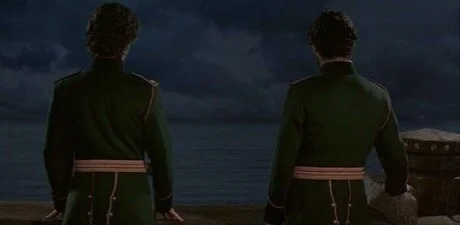
That being said – methods of narrative exposition aside – there are also scenes of immense cinematic potential in Dune. The Wadi Rum-esque deserts, tunnels and carved rock chambers of Arrakis, the spectacle of folding space, and the mining smog and endless honeycomb of dark mechanized warehouses and mining operations on the Harkonnen industrial home world of Giedi Prime all invite Villeneuve to compensate for the turgidity of the novel’s dialogue. His audience will welcome such beauty. Colin O’dell and Michelle LeBlanc, in their book on the cinematic oeuvres of Lynch, write that “…the richness of film lies in the way it draws on all elements of the arts to provide an intoxicating mélange of sight and sound, enticing the viewer with a cavalcade of delights. It is the combination of audio and visual that delivers the message of a film” (157). Again, to turn our critical eye to Lynch, most of the art direction, set-design and world-building of the earlier film does not astound or produce a cavalcade of anything, though he can’t be faulted too sharply. In an effort to faithfully adhere to the novel’s setting, all the book’s dialogue on Caladan takes place in Castle Caladan. Lynch therefore depicted the planet through a series of sparsely lit interior scenes in the castle, with any added environmental texture potentially lost to the editing-room floor. All exterior shots of the Atreides home-planet take place at night, in the rain, within the stone confines of the castle. We are given the sense that it is a wet planet, but no more (fig. 2). The audience rarely sees the ceilings of the indoor sets of Caladan or Arrakis, as the darkness depicts or conceals them in unflattering light. In fact, most of the film takes place in an inexplicable twilight, a half-world intended to convey gravitas. Due to lighting, close angles and composition, most night scenes lack scope as a result — though we are never shown the Arrakeen night sky, one would imagine it being breathtaking above a desert devoid of light pollution. Giedi Prime is reduced to no more than a green-screen cube populated by a few middle-aged men in costume, and as a result the scope and allegory-rich contrast between the industrial Giedi Prime and lush Caladan is hinted at but mostly lost in Lynch’s film. The sets go wholly invalidated by the gloomy lighting and camera work — a shame, since the carvings, facades, and mechanisms seem very detailed and work-intensive. The camera does not track or move often through these sets either, and when it does, it doesn’t compliment the mise-en-scene or positioning of the characters involved. Many of the techniques Lynch used feel gimmicky — he superimposed shots of water droplets over Paul doing a “thinking” face as he (and we) learn of hidden water stores on the desert planet, and often scenes begin with characters entering a space, speaking, and then leaving the space, reinforcing a feeling that the characters are on a stage instead of an alien planet. What’s more, Lynch seems to favor the subliminal and implied at the wrong time, at least relative to how little he strays from the novel at others.
Fig. 2: Paul and the Duke look out from Castle Caladan at night in Dune, (David Lynch, 1984)
A lack of tangible, definitive continuity-editing gives many scenes an insularity, disconnecting them from the scenes that come before and after. This could take root in how much of his original cut the De Laurentiis producers excised, or in the fact that Lynch “…began his career as a fine artist and his films have always had a strong sense of visual style” (O’dell & Le Blanc, 163). Classifying Lynch as the stricken artiste given too much to handle certainly makes some of his decisions more ironic in their perceived laziness and lack of artistry, such as the Atreides troops all dressed in the tan fatigues of World War 2 Allied fighters of some kind. David Foster Wallace describes the “Lynchian” in his 1996 article about the director as “…a particular kind of irony where the very macabre and the very mundane combine in such a way as to reveal the former’s perpetual containment within the latter” (Foster Wallace). Dune is especially so; at times Lynch’s style only gets in the way of the story he tried to tell. Witnessing the scope of Baron Harkonnen’s pederasty subplot condensed into one gory, almost comically homophobic scene — wherein he bathes in oil and then the blood of a young, effeminate man — beaches the character on shallows of Lynch’s design and makes it seem like, directing during the AIDS scare of the eighties, he was possibly trying to reconcile his penchant for the macabre with his misunderstanding of the disease. The legions of bad guys — whether the Sardaukar (the Emperor’s very capable fighters) or the Harkonnen infantry — inexplicably all seem to be wearing the same brand of Hazmat suits, though they are completely different entities. Why? Perhaps this was a cheaper alternative to putting hundreds of extras into makeup every day, but perhaps not, seeing as though Lynch had $40 million dollars to play with. The Spacing Guild navigator whom the audience encounters early in the film looks much like it is described in the book (maybe too much) and yet inspires none of the awe or wonder (fig. 3). Lynch evidently decided to play up the disgust factor and downplay the cosmically-powerful being factor. Much of 1984’s Dune feels confusing, as the viewer gets pulled away from scenes only as they are beginning to understand them and when fully immersed in other scenes, are bewildered. The pace of the film mirrors the massive amount of splicing and cutting the film underwent to shorten it to an acceptable running time.
Fig. 3: Spacing Guild navigator in Dune, (David Lynch, 1984)
Villeneuve, as far as editing goes, will tackle Dune alongside Joe Walker, returning after editing Villeneuve’s Arrival and Blade Runner 2049, both of which are masterfully paced (Desowitz). Walker had to compact an initial four-hour cut of Blade Runner down to its final two hours and forty-four minutes (Scharf), bringing to mind how a very similar editing process left Lynch’s movie so corrupted. Walker has said that he “… [doesn’t] want to overload it too much with the older film and reading the book [and] just want[s] to see what [Denis’] vision is” (Ibid). Walker obviously respects Villeneuve artistry; it would be safe to say the two have (and have had) a fruitful working relationship. As 2020’s Dune will inadvertently end up with a lengthy initial (and probably final) cut, it bodes well that a seasoned editor like Walker is on board. The look of the film will prove to be more synonymous with the expansive feeling of the novel, as well. The dark nature of Lynch’s film feels almost accidental, whereas Villeneuve and whatever cinematographer he works with tend to intentionally craft films out of darker tones, with clashing colors emphasizing unease and tension, and shifting color palettes mimicking character transformation (fig. 4). Villeneuve also works with people who know how to beautifully depict a location or set. Arrival’s cinematographer, Bradford Young, referenced a book on Swedish motocross racers who race at night (Daron), and Villeneuve and Roger Deakins created a magnificent, dark Los Angeles in Blade Runner 2049. In fact, the L.A. of 2049 imparts the same sense of scale and flickering-neon hopelessness that the Giedi Prime of the novel does, which describes the planet as an industrial wasteland whose environment has been irredeemably devastated by industrial pollution. The streets are full of “…rubbish heaps [and] scabrous brown walls reflected in the dark puddles of the streets, and the furtive scurrying of the people” (Herbert, 210). Upon viewing Villeneuve’s Blade Runner 2049, one can imagine what justice he could do to Giedi Prime. The fact that Villeneuve is not working with Deakins on Dune but with cinematographer Greig Fraser (Lion, Foxcatcher, Zero Dark Thirty) (Sharf) makes one wonder whether Deakins chose to not risk being part of another Dune flop, if scheduling conflicts made it impossible, or if Villeneuve simply thought that Fraser’s style suited the film better. Villeneuve’s recent films have been science-fiction masterpieces with some very impressive visual effects, both practical and computer-generated. With that said, he “…is never going to throw humility and sensitivity out for a visual spectacle” (Daron), so it seems fair to conclude that his interpretation of Dune will do justice not only to the tone and scale of the Arrakeen desert or Caladan’s rivers and plains but the more intricate, intertextual material of Herbert’s novel as well.
Fig. 4: Cinematography in Blade Runner: 2049 (Denis Villeneuve, 2018)
One of the greatest lessons Lynch imparted was the importance of the soundscape of Dune. The soundtrack, which credits both Brian Eno and Toto, “…manages simultaneously to cheapen and date the film, with quite breathtaking ease” (O’dell & Le Blanc, 51). Toto’s bombastic score largely overwhelmed the drenched, ethereal sound of Eno. Of Lynch’s films, “Dune is perhaps the one film where the music doesn’t work” (O’dell & Le Blanc, 160). In diegetic terms, the film seems to squander opportunities. Various scenes depicting water, for instance – which figures so importantly in plot and theme – are twinned to almost comically artificial soundtracks. They do not provide sonic texture so much as obvious auditory signage for the audience. The Spacing Guild navigator arrives in a nimbus of steam and rubber-clad bodyguards, the sounds of which feel cheap and secondary to their looks. Encased in a rolling container full of spice-gas, the navigator’s voice brings to mind a second-rate Darth Vader, failing to communicate the size or power of its being. The lack of a non-diegetic, atmospheric sound-tracking here feels like a missed opportunity on Lynch’s part. Denis Villeneuve, by contrast, has regularly employed sound effects more shrewdly. The ominous tones mixed with high-pitched whines – reminiscent of whale-calls – that play as we first see the spaceship in Arrival tell us exactly how to feel. The sound of the scalding-hot shower, rising steam, and screams of Paul Dano’s character in Prisoners questions our view of the purported antagonist – humanizing him through sheer, horrifying sonic texture. The soundscapes of Villeneuve’s films are famously well-crafted, contributing to audience engrossment.
Another skill of the French-Canadian director is casting. With a number of notable actors already signed on to the project, Villeneuve’s adaptation of Dune seems to be off to a good start. The young star Timothée Chalomet has been cast as the protagonist, Paul Atreides. Along with fitting the visual profile of the character very well, Chalomet brings with him an attractive star power that Lynch steered away from into when casting then-unknown Kyle MacLachlan as his Paul. Sting – cast as baddie Feyd Ruatha – struggled to be anything but Sting. (One scene where his uncle, Baron Harkonnen, leers at him as Sting exits a steam-bath wearing a leather thong strikes one as particularly Lynchian). Chalomet has proven himself to be a very capable actor in the recent Call Me By Your Name and Beautiful Boy, with the nuance that could give the on-screen character of Paul Atreides a depth the potato-faced MacLachlan did not have. Villeneuve has certain character actors he works with in many of his who lend themselves to smaller, memorable roles. One such actor is David Dastmalchian, who starred in Prisoners and Blade Runner: 2049, returning to play the character of Peter DeVries in Dune (N’Duka, 2019). Also returning to work with Villeneuve, Dave Bautista has been cast as Glossu “Beast” Rabban Harkonnen, the tormenter enlisted by house Harkonnen to keep the Fremen subdued (Kroll, 2019). Rabban is described as an animal, but given dimension through the novel’s description of his struggle to appease the Baron Harkonnen. Paul Smith, who plays Rabban in Lynch’s Dune, is middle-aged and thick of build though not in a very imposing way. In most of his scenes he is a foil for and overshadowed by Keneth McMillian’s much better acted and more viscerally interesting Baron Harkkonnen. In one unintentionally funny exchange, he stuffs his face with food as the Baron explains the cruelty he expects from Rabban on Arrakis (fig. 5). Bautista brought an excellent, understated vulnerability to his role as a replicant at the beginning of Bladerunner, which sticks with the viewer long after his death. His style of acting and leathered physicality suits the character much better. Oscar Isaac is rumored to be playing the Duke Atreides in Villeneuve’s film, alongside other big names such as Javier Bardem, Stellan Skarsgård, Josh Brolin, Jason Momoa, and Rebecca Ferguson (Kroll, 2019). Of course, a dated quality in Lynch’s film its absence of strong female roles, a vacuum not entirely of his own creation but which mirrors the novel’s. Herbert treats Arrakis as a male demense – women are generally marginalized. Among them are Lady Jessica, Chani (Paul’s Fremen bride), and Reverend Mother Gaius Helen Mohiam, Lady Jessica’s superior in the matriarchal hierarchy of the Bene Gesserit. The Bene-Gesserit order — powerful and highly intelligent — offer impressive female role models, but the women in the book are a latticework on which the male characters support themselves. Compounding Herbert’s gender imbalance, Lynch robbed these female characters of their panache. He depicted the Bene Gesserit order as especially impotent, when in reality they are some of the most powerful beings in Herbert’s universe. In comparison, Villeneuve has humanized his past films through appealing female leads and supporting roles, from Amy Adams in Arrival to Mélissa Désormeaux-Poulin in Incendies. His Dune should do likewise.
Fig. 5: Paul Smith’s ‘Beast Rabban’ alongside Sting's Feyd-Rautha in Dune , (David Lynch, 1984)
In the end, however, this optimism is speculation. Until November 2020, when Villeneuve’s Dune is released (Duneinfo, 2019, lovers of his work can only hope. This paper has suggested that a film with both commercial and aesthetic virtues will take the source material seriously, as Villeneuve has promised. It will solve the riddle of exposition through interior monologue, on which so much of the novel depends. It will enliven, or at least make plausible, the stentorian quality of the book’s original dialogue, and mediate between sharing too much and too little of this dialogue with the viewer. As fans of his work will attest, Villeneuve’s apparent strengths seem perfectly suited to this project — the set-design, soundscapes, cinematography, editing, dialogue, and tone of his past films are those of a director comfortable and well-versed in the genre. His Dune will of course benefit from massive advances in computer animation since Lynch’s effort, but more importantly it will reflect his admiration for Herbert’s novel. We could say that were the two films currently in theatres, with Lynch the beneficiary of CGI and more sophisticated precedents for such escapism, this paper might have read differently. But 36 years will have passed between these projects. Like so many other readers of Herbert’s masterwork, I await the new film with relish — fascinated to see how Villeneuve depicts a character like Duncan Idaho, or scores the action. I merely dream that my visions of sand worms, deserts, and limitless skies of Herbert’s universe match those of Denis Villeneuve.
Property of Liam Shannon
Behold, as a wild ass in the desert, go I forth to my work,
or
Why David Lynch failed in adapting Dune, and why Denis Villeneuve might just succeed
(Note from 2022 Liam: take this paper with a grain of salt, please.)
(2019)
Having again read Frank Herbert’s seminal novel Dune this past summer at an important juncture in my life, I was inspired to watch the 1984 film adaptation. Scores of critical reviews of David Lynch’s adaptation – then costing Universal some $40 million – have since confirmed my and many others’ impression that the film was a bloated failure. Far from lessening my interest in the book, however, the film intrigued me – I found myself questioning what had led to the discrepancy between what I’d read and enjoyed so recently and what the critic Roger Ebert called “…an incomprehensible, ugly, unstructured, pointless excursion into the murkier realms of one of the most confusing screenplays of all time” (1984). Short of another op-ed about why David Lynch should be defenestrated for his work on the film – a opinion which I believe to be more unfair than not – this paper discusses why Lynch faltered. It asks why the novel, so wildly popular to a generation of readers, should prove such a daunting project to film. The question, of course, grew even more interesting to the film community when news broke that Denis Villeneuve had assumed control of the next adaptation of the novel. Everything Villeneuve has directed, I’ve loved. With him in the picture, my question changed from “where did Lynch mess up” to “why did Lynch falter, and how could Villeneuve manage to do Dune justice where Lynch could not?” By analyzing the source text, Lynch’s film, the wealth of commentary on the film that has sprung up since its release, and Villeneuve’s past work, I believe one can map a constellation of what it means to adapt Herbert’s novel – and the potential dangers of the same. Though the stylistic pitfalls of the 1984 film are the central tenets of this paper, I hope to also explain why I believe 2020’s Dune will prove a critical success. I will initially review the process of Lynch creating a film he did not have total control over, and how his artistic choices – and skill set – were maladapted to the project. I will describe those aspects of the film that did not work in some detail -- cinematography, art direction, editing, soundscape, lighting, and even casting -- and the related aspects of Villeneuve’s past work that absolutely confirm my opinion that he is perfectly suited for the job.
Dune takes place far in the cosmic future, and follows the young Paul Atreides as his house transitions from their water-rich, idyllic home world of Caladan to the desert planet Arrakis. Only on Arrakis – colloquially known as Dune – can the spice melange be found, a galactic fuel and currency that improves health and augments prescience. The Harkonnens, another galactic lineage who have a vested interest in the downfall of their rival house, plan on attacking the Atreides upon their arrival on Arrakis, whose spice harvesting operations the Harkonnens formerly owned. The combination of tension between the two houses, mercurial relations with the native Fremen people, the extreme water shortage, and the menacing sand-worms (gargantuan creatures in the deep desert that are attracted to sound and consume melange) set a very hostile stage for house Atreides. Soon after arriving they are set upon and all but extinguished. Shortly thereafter, the Harkonnens land on Arrakis and — by decree and with the military backing of the Emperor — begin to hunt the Atreides. Paul’s mentor figures are scattered or killed. He and his mother, Jessica, escape into a powerful sandstorm and ride its turbulence to safety deeper in the desert. They are found by a troupe of Fremen, the native populace of Dune, and are offered protection after proving their worth. Through a series of maneuvers made by the increasingly powerful and prescient Paul, the Fremen rise up against the Empire and the Harkonnens. The plot chronicles the young Atreides as he transforms into Mau’dib, the all-seeing leader of Fremen prophesy, expanding his consciousness through consuming the concentrated spice bile of the sand-worms.
Sharing the Hugo award with Roger Zelatny’s This Immortal in 1966, Frank Herbert’s Dune has since been hailed as one of the defining science-fiction classics of our time, going on to sell over 12 million copies (Stasio, 2000). Hollywood could not have ignored the potential of the novel, though it didn’t come quietly. Arthur P. Jacobs optioned the rights to a Dune film in 1971 before suffering a heart attack at age 51. Alejandro Jodorowsky, described as “a visionary” by Denis Villeneuve (Fandom, 2018) created and cast his own expansive version of Herbert’s universe with the help of an army of character-design artists and visual-effects wizards before a lack of funding forced dormancy on the film again. Many well-known special effects artists made their name in this process, including H.R. Giger, the mind behind the “…psycho-sexually arresting look of Alien” (Ellison, 599). Under the umbrella of a French consortium, Dino De Laurentiis purchased the rights to the film in 1976, hiring Ridley Scott in 1979 as the director. After Scott realized it would take a few years to bring Dune to fruition and his “…older brother Frank unexpectedly died of cancer while [he] was prepping the De Laurentiis picture” (Sammon, 112), he backed away from the project. “A viewing of The Elephant Man led the producers, [namely Rafaella, Dino’s daughter,] to approach Lynch [granting the young director] around $40 million, a massive amount at the time, making it one of the most expensive films ever made — also allowing him to develop the script, the very stumbling block that had caused previous attempts to falter. Lynch was to turn in eight drafts of a Dune script before he was happy” (Le Blanc and ODell, 45). Eventually, after months of filming with a crew of 1700 in the Mexican desert, the film was edited down from an initial four-hour rough cut to something closer to half that length (Murphy, 1996). Lynch has stated repeatedly in interviews since, with obvious measures heartbreak and disdain, that he wasn’t given final cut on the film, regretting signing up to “…make a film that [couldn’t] be the film [he wanted] to make” (DuneInfo, 2012). Unhappy with the film’s corrosion, Lynch sued to have his name expunged from its television version. His directing credit has generally been replaced by “Alan Smithee” since that time (Murphy, 1996).
After early screenings of Dune, word-of-mouth spread quickly — under doorways and over phone-calls — that the film was an unmitigated disaster. Notable film critic Harlan Ellison reports that Frank Price, chairman of MCA/ Universal Motion Picture Group at the time, declared “[the film] a dog. It’s gonna drop dead. We’re going to take a bath on it. Nobody will understand it!” (Ellison, 623). He said something of the sort publicly enough for a nebulous sense of dread to ripple out over the entire Universal lot as word of the $40 million-dollar failure spread. Before it had even really begun its press buildup, the film was branded high and low as faulty merchandise. “Of a sudden, Dune was not a film to be seen by the laity” (Ibid, 636). He writes of a screening in New York where one attendee sprang to their feet after the viewing and shouted “When are you going to stop making shit like this? When are you going to give us a picture we can play that will make some money? Are you trying to kill us?” (Ibid). Ellison was approached by USA Today to write up a review of the film; upon arriving at a screening on the 30th of November, 1984 he was barred from entry out of fear of a bad review by an apologetic bouncer (Ibid, 628). Twenty-four days after Ellison was forbidden to attend the screening of it, Dune was released worldwide (Duneinfo, 2012). Frank Herbert, interviewed at his home in Manhattan Beach after having seen an early screening of the film, said that “It begins as Dune begins, it ends as Dune ends and I hear my dialogue throughout. How much more could a writer want?” (Ellison, 626).
Of course, therein lies much of the problem; Lynch’s Dune collapsed under the weight of depicting the source-text too faithfully. Endeavoring to pay homage to all of Herbert’s universe, it exposed its audience to a confusing miasma of detail, a panorama of odd and discordant parts. Eventually, of course, large parts of the film were whittled away — the original cut ran well over four hours — to save through excision a venture many were then becoming unsure of. To work on screen, especially in a single film, the Herbert’s book had to be condensed considerably but retain its momentum and cohesiveness. It wasn’t, and as a result, the film feels dense without mass. As author Thomas Leitch states, “Three hundred page novels cannot be adapted to feature length films without a great deal of systematic elision and omission” (99). Dune called for a “…combination technician and administrator” (Foster Wallace); Lynch is as much the first as he isn’t the second. His prior film, Eraserhead, had been a tiny operation with a small and largely unpaid crew, whereas everything in Dune was filmed from four different angles (Murphy, 1996) and had a cast the size of “…a small Caribbean nation” (Foster Wallace). Perforce, Lynch ultimately proved unequal to the task — as Roger Ebert stated, “Dune look[ed] like a project that was seriously out of control from the start” (1984). While the physical challenge of making a $40 million-dollar film in the searing heat of the Mexican desert would have daunted any director, he also had to mediate between the film’s underwriters — obviously clamouring for a marketable film — and the novel’s length and complexity. With no room to breathe, the film’s audience never gets a real chance to lose themselves in a story that deserves it. As one critic puts it, “Standard tactics of adaptation — selecting some obligatory speeches, characters, scenes, and plotlines and dropping others, compressing or combining several characters or scenes into one; streamlining the narrative by eliminating digressive episodes; reworking dialogue so that it is either more epigrammatic or more severely functional — [were] clearly inadequate” (Harwood, 129) in the case of Lynch’s Dune.
Could another director have done better? “Standard tactics of adaptation” of the novel must contend with its superflux of alien place and character names. Kwisatz Haderach? Gom Jabbar? In other sagas, such as the Star Wars films, the strange place and character names and institutions of the universe are for the most part aesthetic and non-inhibiting, “…analogous to verbal art design; there to provide texture.” These same details in the novel are “…integral to the narrative” of Dune (Odell & Le Blanc, 47). The audience needs to know these names and their meaning; without them, the film lacks cohesion. A character will mention something once which won’t resurface, if at all, until later in the film. CHOAM (Combine Honnete Ober Advancer Mercantiles), a sort of economic super-power which controls all trade in the galaxy and a relatively important aspect of the novel, is brought up three times in passing only in its abbreviated form. Cervantes posits that “Plots in fiction should be wedded to the understanding of the reader” (442), but what is a close union in novel form unraveled quite spectacularly in Lynch’s adaption. If anything, his Dune simply tried to be something it didn’t have the time to be, though it is important to say that even if released as Lynch’s original unedited version it most probably still wouldn’t have paid proper homage to the central tenet of Herbert’s novel.
In truth, the beating heart of the book is the same thing that initially interested Herbert: science, desert ecology, and environmental systems. Frank Herbert travelled to the coastal town of Florence, Oregon in 1957 to study the dunes there (McNelly, 1969) and his son, Brian Herbert, explains that “[his] father emphasized a world view of living in harmony with nature [and] the dunes got him thinking more about man’s involvement in relation to it” (Hahn). In the mid 1950s, drifting sands were beginning to pose a threat to the railroads, highways, local water supplies, and vegetation of the area. In a coordinated agricultural rebuttal, the U.S. Federal Government planted legions of European beach grass along the coast between Florence and Coos Bay. Herbert took a small chartered plane over the dunes and witnessed from above the deliberate, fluid danger the sand posed. He wrote to his literary agent Lurton Blassingame that, left to it, the dunes could “swallow whole cities, lakes, rivers, [&] highways,” and how he saw that the government was beginning to “…control the flow of sand dunes” by sowing them with the grass (Herbert et. al, 264). He dedicated the next five years to studying the dunes. Despite doing so initially for an article about the area called “They Stopped the Moving Sands,” the amount of material proved too massive for easy synthesis, and the article fell to the wayside. But something had crystallized out of his sustained environmental studies — his time near Florence had impacted him greatly, and he was “…fascinated by sand dunes” (McNelly, 1969). They would form the nucleus of his 1965 novel, the European beach grass his protagonist. The discovery that Arrakis hosts an abundance of life attuned to its hardships mirrors the interest Herbert took in researching his “They Stopped The Moving Sands” article. The dedication at the beginning of Dune, “To the people whose labors go beyond ideas into the realm of ‘real materials’ — to the dry-land ecologists, wherever they may be, in whatever time they work, this effort at prediction is dedicated in humility and admiration” (Herbert, 3), speaks for itself. Liet Kynes, the Fremen leader upon Paul’s arrival on Arrakis, dreams in parallel with his people of a green future for their planet. His environmentally conscious point of view and scientific mind are diegetic expressions of Herbert, Kynes a meta-personification of the author himself. He saw his creation — the world of Arrakis — as an entity within the story exactly as important as any character. In the 1984 foreword for Heretics of Dune, Herbert writes that he intended “…to produce another view of a human-occupied planet as an energy machine. [Dune] was to penetrate the interlocked working of politics and economics” (Herbert, 2). All this to say that Lynch adapting Dune and siphoning importance away from this aspect of the story — man’s relation to the environment — robbed the adaptation of its essence, its actual thematic marrow. Lynch too rarely depicted, much less flattered the landscapes and topographies of the Herbert’s alien worlds, casting them more as an annoyance, their beauty second only to their harshness (fig. 1), whereas Herbert saw this harshness and beauty as two sides of the same coin. To succeed, a film adaptation of Dune must take the novel’s environmental theme more seriously.
Fig. 1: The uninspiring desert-scape of Lynch’s Arrakis in Dune, (David Lynch, 1984)
On the topic of viewing Blade Runner for the first time as a fourteen-year-old, Denis Villeneuve says “It was something [he] was deeply looking for: someone who would take sci-fi seriously. In literature, it’s a serious genre […] Isaac Asimov, Frank Herbert, Arthur C. Clarke. Those artists [took] sci-fi seriously” (Mottram, 26). Thirty-seven years later and Villeneuve has been signed on to direct the next adaptation of Dune. After helming a string of hugely successful movies (his most recent, Bladerunner: 2049, earning $259.2 million) Villeneuve has proven his directorial merit. It bodes well that in many ways the narrative of Dune resembles Villeneuve’s 2016 Arrival. Both depict a sudden changing of their protagonist’s world, resulting in a spiritual awakening that is of cosmic importance. Both feature what we would call aliens. Both are more than plot-driven escapism, aspiring instead to the cerebral. Denis Villeneuve himself said a few years before Dune was his to direct that “…it’s always difficult to find original and strong material that’s not just about weaponry” (Martin). Of course, the more cerebral nature of the story makes for some difficulty in narrative exposition, but Villeneuve demonstrated in Arrival that he can do extra-terrestrial and philosophical. Nevertheless, adapting Dune for a 2020 audience raises discrete challenges — ones not confronted by Lynch. For one thing, aspects of the book will seem dated today if not treated with a certain grace, such as the depraved tendencies of Baron Harkonnen, the white-savior narrative of Paul guiding the Fremen, and overwhelming male-centricity of the novel. They now seem retrograde in Lynch’s film. However, Villeneuve will have access to something Lynch did not: the benefit of referencing Lynch’s film. “Many filmmakers make contributions so definitive to the films on which they collaborate that their hand is instantly recognizable” (Leitch, 237); perhaps Lynch’s contribution to the canon of Dune was that of a pathfinder, even a martyr. Though he had access to a wealth of resources, to be fair to Mr. Lynch, “…not all adaptations are created equal” (Leitch, 93), and with less experience on large-scale shoots and a massive amount of material to convey to the audience, Lynch’s adaptation began at a serious disadvantage. The size of the undertaking was always going to be at odds with his insular directorial style, wherein his creative control is paramount. Lynch’s dedication to his own vision is “…[indicative of either] raging egotism or passionate dedication or a childlike desire to run the sandbox, or all three” (Foster Wallace). The same thing that made the smaller-scale Eraserhead work did not scale up accordingly for Dune. It would of course be impossible to have directly overseen every aspect of a shoot the size of Dune’s. Earlier versions of the script showed that Lynch had epic plans for the width and breadth of his film, but each successive version of the script reads as more streamlined and less voluminous (Lynch, 1982). As author and playwright Ronald Harwood said, “The commercial has enormously influenced the cinema […] to the cinema’s detriment” (12). In this respect, Villeneuve has achieved a fine balance between appealing to the masses and the pipe-and-beret crowd. Both directors have their styles, though Villeneuve’s is more flexible. From his more avant-garde 2013 film Enemy to his most recent blockbuster Blade Runner: 2049, he always manages to make movies that are both visually stunning and tonally memorable, each one very much a Villeneuve film.
For all its scope, the written world of Dune contains far less flair than some of the other large space sagas of our time. The Atreides home world is described as lush and green, but very fleetingly at that: “…the open skies of Caladan with cloud fleece on the horizon promising rain” (Herbert, 284) don’t strike one as overtly alien. Herbert’s Dune is soft science-fiction, so to speak. The narrative avoids the technological fever-dream and spaceship porn of some rival depictions of the future, instead casting far into time the difficulties people have always faced. Donald A. Russell states that “…the essentials in a narrative work are the hopes and human fears, the participation in the vicissitudes of the characters to which a true human interest is born, even knowing they are invented” (1461b 10-11). Couched in the fantastical and mythic, Herbert’s story manages to orbit concepts intrinsic to humanity. If anything, Dune is the chronicle of Paul’s “…awakening of consciousness and journey to enlightenment” (Odell & Le Blanc, 48). Most of this enlightenment takes place in the dream-like innermost sanctum of Paul’s mind, where he slowly learns to understand “...the massive steadiness of time’s movement everywhere complicated by shifting currents, waves, surges and counter surges, like surf against rocky cliffs” (Herbert, 193). These integral scenes are by their very nature difficult to film. Any adaptation, without cheapening itself (as Lynch’s did) with abundant voiceovers — in which the characters not doing the think-speaking wait politely in deflated silence for it to be over — must divert some focus towards the tangibles of Dune’s adventure narrative to stay afloat. Leitch declares that “…by far the most common approach to adaptation is adjustment, whereby a promising earlier text is rendered more suitable for filming by one or more of a wide variety of strategies” (98).
The trick to adapting Dune, then, lies in balancing the spatial grandeur of the story and the quickening expansion of Paul’s mind — in moving the events of the story forward while psychologizing and developing Paul. With most of the novel’s character development either taking place through internal monologue or dialogue suffused with background-information any film adaptation risks “the ventriloquism trap,” where an author conveys all information through dialogue, using characters’ speech as a ventriloquist would a dummy. That such exposition harms realism goes without saying, as real people don’t talk this way. To choose an example from the Lynch adaptation, Princess Irulan’s prologue in the beginning of the film was “…very successful in confusing the audience by throwing a lot of information at them without any visual detail to support it” (Murphy, 1996) — there must have been a board-room fear of losing the audience before the film had gotten underway. Much of Lynch’s film committed this sin — talk between the characters feels sclerotic, stiffened by all the information they must convey to keep the viewer informed. When walking to the entrance of Castle Caladan to welcome the Reverend Mother Gaius Helen Mohiam, Lady Jessica (generously) reveals to us through voiceover and an anxious face that she knows “…[the Reverend Mother] has come to test him. No man has ever been tested with the box… only Bene Gesserit women. [She] may lose [her] son.” The question for any director tackling Dune is how to maintain realism while respecting the somewhat artificial volubility of the original text —- the logorrhea of the characters.
That being said – methods of narrative exposition aside – there are also scenes of immense cinematic potential in Dune. The Wadi Rum-esque deserts, tunnels and carved rock chambers of Arrakis, the spectacle of folding space, and the mining smog and endless honeycomb of dark mechanized warehouses and mining operations on the Harkonnen industrial home world of Giedi Prime all invite Villeneuve to compensate for the turgidity of the novel’s dialogue. His audience will welcome such beauty. Colin O’dell and Michelle LeBlanc, in their book on the cinematic oeuvres of Lynch, write that “…the richness of film lies in the way it draws on all elements of the arts to provide an intoxicating mélange of sight and sound, enticing the viewer with a cavalcade of delights. It is the combination of audio and visual that delivers the message of a film” (157). Again, to turn our critical eye to Lynch, most of the art direction, set-design and world-building of the earlier film does not astound or produce a cavalcade of anything, though he can’t be faulted too sharply. In an effort to faithfully adhere to the novel’s setting, all the book’s dialogue on Caladan takes place in Castle Caladan. Lynch therefore depicted the planet through a series of sparsely lit interior scenes in the castle, with any added environmental texture potentially lost to the editing-room floor. All exterior shots of the Atreides home-planet take place at night, in the rain, within the stone confines of the castle. We are given the sense that it is a wet planet, but no more (fig. 2). The audience rarely sees the ceilings of the indoor sets of Caladan or Arrakis, as the darkness depicts or conceals them in unflattering light. In fact, most of the film takes place in an inexplicable twilight, a half-world intended to convey gravitas. Due to lighting, close angles and composition, most night scenes lack scope as a result — though we are never shown the Arrakeen night sky, one would imagine it being breathtaking above a desert devoid of light pollution. Giedi Prime is reduced to no more than a green-screen cube populated by a few middle-aged men in costume, and as a result the scope and allegory-rich contrast between the industrial Giedi Prime and lush Caladan is hinted at but mostly lost in Lynch’s film. The sets go wholly invalidated by the gloomy lighting and camera work — a shame, since the carvings, facades, and mechanisms seem very detailed and work-intensive. The camera does not track or move often through these sets either, and when it does, it doesn’t compliment the mise-en-scene or positioning of the characters involved. Many of the techniques Lynch used feel gimmicky — he superimposed shots of water droplets over Paul doing a “thinking” face as he (and we) learn of hidden water stores on the desert planet, and often scenes begin with characters entering a space, speaking, and then leaving the space, reinforcing a feeling that the characters are on a stage instead of an alien planet. What’s more, Lynch seems to favor the subliminal and implied at the wrong time, at least relative to how little he strays from the novel at others.
Fig. 2: Paul and the Duke look out from Castle Caladan at night in Dune, (David Lynch, 1984)
A lack of tangible, definitive continuity-editing gives many scenes an insularity, disconnecting them from the scenes that come before and after. This could take root in how much of his original cut the De Laurentiis producers excised, or in the fact that Lynch “…began his career as a fine artist and his films have always had a strong sense of visual style” (O’dell & Le Blanc, 163). Classifying Lynch as the stricken artiste given too much to handle certainly makes some of his decisions more ironic in their perceived laziness and lack of artistry, such as the Atreides troops all dressed in the tan fatigues of World War 2 Allied fighters of some kind. David Foster Wallace describes the “Lynchian” in his 1996 article about the director as “…a particular kind of irony where the very macabre and the very mundane combine in such a way as to reveal the former’s perpetual containment within the latter” (Foster Wallace). Dune is especially so; at times Lynch’s style only gets in the way of the story he tried to tell. Witnessing the scope of Baron Harkonnen’s pederasty subplot condensed into one gory, almost comically homophobic scene — wherein he bathes in oil and then the blood of a young, effeminate man — beaches the character on shallows of Lynch’s design and makes it seem like, directing during the AIDS scare of the eighties, he was possibly trying to reconcile his penchant for the macabre with his misunderstanding of the disease. The legions of bad guys — whether the Sardaukar (the Emperor’s very capable fighters) or the Harkonnen infantry — inexplicably all seem to be wearing the same brand of Hazmat suits, though they are completely different entities. Why? Perhaps this was a cheaper alternative to putting hundreds of extras into makeup every day, but perhaps not, seeing as though Lynch had $40 million dollars to play with. The Spacing Guild navigator whom the audience encounters early in the film looks much like it is described in the book (maybe too much) and yet inspires none of the awe or wonder (fig. 3). Lynch evidently decided to play up the disgust factor and downplay the cosmically-powerful being factor. Much of 1984’s Dune feels confusing, as the viewer gets pulled away from scenes only as they are beginning to understand them and when fully immersed in other scenes, are bewildered. The pace of the film mirrors the massive amount of splicing and cutting the film underwent to shorten it to an acceptable running time.
Fig. 3: Spacing Guild navigator in Dune, (David Lynch, 1984)
Villeneuve, as far as editing goes, will tackle Dune alongside Joe Walker, returning after editing Villeneuve’s Arrival and Blade Runner 2049, both of which are masterfully paced (Desowitz). Walker had to compact an initial four-hour cut of Blade Runner down to its final two hours and forty-four minutes (Scharf), bringing to mind how a very similar editing process left Lynch’s movie so corrupted. Walker has said that he “… [doesn’t] want to overload it too much with the older film and reading the book [and] just want[s] to see what [Denis’] vision is” (Ibid). Walker obviously respects Villeneuve artistry; it would be safe to say the two have (and have had) a fruitful working relationship. As 2020’s Dune will inadvertently end up with a lengthy initial (and probably final) cut, it bodes well that a seasoned editor like Walker is on board. The look of the film will prove to be more synonymous with the expansive feeling of the novel, as well. The dark nature of Lynch’s film feels almost accidental, whereas Villeneuve and whatever cinematographer he works with tend to intentionally craft films out of darker tones, with clashing colors emphasizing unease and tension, and shifting color palettes mimicking character transformation (fig. 4). Villeneuve also works with people who know how to beautifully depict a location or set. Arrival’s cinematographer, Bradford Young, referenced a book on Swedish motocross racers who race at night (Daron), and Villeneuve and Roger Deakins created a magnificent, dark Los Angeles in Blade Runner 2049. In fact, the L.A. of 2049 imparts the same sense of scale and flickering-neon hopelessness that the Giedi Prime of the novel does, which describes the planet as an industrial wasteland whose environment has been irredeemably devastated by industrial pollution. The streets are full of “…rubbish heaps [and] scabrous brown walls reflected in the dark puddles of the streets, and the furtive scurrying of the people” (Herbert, 210). Upon viewing Villeneuve’s Blade Runner 2049, one can imagine what justice he could do to Giedi Prime. The fact that Villeneuve is not working with Deakins on Dune but with cinematographer Greig Fraser (Lion, Foxcatcher, Zero Dark Thirty) (Sharf) makes one wonder whether Deakins chose to not risk being part of another Dune flop, if scheduling conflicts made it impossible, or if Villeneuve simply thought that Fraser’s style suited the film better. Villeneuve’s recent films have been science-fiction masterpieces with some very impressive visual effects, both practical and computer-generated. With that said, he “…is never going to throw humility and sensitivity out for a visual spectacle” (Daron), so it seems fair to conclude that his interpretation of Dune will do justice not only to the tone and scale of the Arrakeen desert or Caladan’s rivers and plains but the more intricate, intertextual material of Herbert’s novel as well.
Fig. 4: Cinematography in Blade Runner: 2049 (Denis Villeneuve, 2018)
One of the greatest lessons Lynch imparted was the importance of the soundscape of Dune. The soundtrack, which credits both Brian Eno and Toto, “…manages simultaneously to cheapen and date the film, with quite breathtaking ease” (O’dell & Le Blanc, 51). Toto’s bombastic score largely overwhelmed the drenched, ethereal sound of Eno. Of Lynch’s films, “Dune is perhaps the one film where the music doesn’t work” (O’dell & Le Blanc, 160). In diegetic terms, the film seems to squander opportunities. Various scenes depicting water, for instance – which figures so importantly in plot and theme – are twinned to almost comically artificial soundtracks. They do not provide sonic texture so much as obvious auditory signage for the audience. The Spacing Guild navigator arrives in a nimbus of steam and rubber-clad bodyguards, the sounds of which feel cheap and secondary to their looks. Encased in a rolling container full of spice-gas, the navigator’s voice brings to mind a second-rate Darth Vader, failing to communicate the size or power of its being. The lack of a non-diegetic, atmospheric sound-tracking here feels like a missed opportunity on Lynch’s part. Denis Villeneuve, by contrast, has regularly employed sound effects more shrewdly. The ominous tones mixed with high-pitched whines – reminiscent of whale-calls – that play as we first see the spaceship in Arrival tell us exactly how to feel. The sound of the scalding-hot shower, rising steam, and screams of Paul Dano’s character in Prisoners questions our view of the purported antagonist – humanizing him through sheer, horrifying sonic texture. The soundscapes of Villeneuve’s films are famously well-crafted, contributing to audience engrossment.
Another skill of the French-Canadian director is casting. With a number of notable actors already signed on to the project, Villeneuve’s adaptation of Dune seems to be off to a good start. The young star Timothée Chalomet has been cast as the protagonist, Paul Atreides. Along with fitting the visual profile of the character very well, Chalomet brings with him an attractive star power that Lynch steered away from into when casting then-unknown Kyle MacLachlan as his Paul. Sting – cast as baddie Feyd Ruatha – struggled to be anything but Sting. (One scene where his uncle, Baron Harkonnen, leers at him as Sting exits a steam-bath wearing a leather thong strikes one as particularly Lynchian). Chalomet has proven himself to be a very capable actor in the recent Call Me By Your Name and Beautiful Boy, with the nuance that could give the on-screen character of Paul Atreides a depth the potato-faced MacLachlan did not have. Villeneuve has certain character actors he works with in many of his who lend themselves to smaller, memorable roles. One such actor is David Dastmalchian, who starred in Prisoners and Blade Runner: 2049, returning to play the character of Peter DeVries in Dune (N’Duka, 2019). Also returning to work with Villeneuve, Dave Bautista has been cast as Glossu “Beast” Rabban Harkonnen, the tormenter enlisted by house Harkonnen to keep the Fremen subdued (Kroll, 2019). Rabban is described as an animal, but given dimension through the novel’s description of his struggle to appease the Baron Harkonnen. Paul Smith, who plays Rabban in Lynch’s Dune, is middle-aged and thick of build though not in a very imposing way. In most of his scenes he is a foil for and overshadowed by Keneth McMillian’s much better acted and more viscerally interesting Baron Harkkonnen. In one unintentionally funny exchange, he stuffs his face with food as the Baron explains the cruelty he expects from Rabban on Arrakis (fig. 5). Bautista brought an excellent, understated vulnerability to his role as a replicant at the beginning of Bladerunner, which sticks with the viewer long after his death. His style of acting and leathered physicality suits the character much better. Oscar Isaac is rumored to be playing the Duke Atreides in Villeneuve’s film, alongside other big names such as Javier Bardem, Stellan Skarsgård, Josh Brolin, Jason Momoa, and Rebecca Ferguson (Kroll, 2019). Of course, a dated quality in Lynch’s film its absence of strong female roles, a vacuum not entirely of his own creation but which mirrors the novel’s. Herbert treats Arrakis as a male demense – women are generally marginalized. Among them are Lady Jessica, Chani (Paul’s Fremen bride), and Reverend Mother Gaius Helen Mohiam, Lady Jessica’s superior in the matriarchal hierarchy of the Bene Gesserit. The Bene-Gesserit order — powerful and highly intelligent — offer impressive female role models, but the women in the book are a latticework on which the male characters support themselves. Compounding Herbert’s gender imbalance, Lynch robbed these female characters of their panache. He depicted the Bene Gesserit order as especially impotent, when in reality they are some of the most powerful beings in Herbert’s universe. In comparison, Villeneuve has humanized his past films through appealing female leads and supporting roles, from Amy Adams in Arrival to Mélissa Désormeaux-Poulin in Incendies. His Dune should do likewise.
Fig. 5: Paul Smith’s ‘Beast Rabban’ alongside Sting's Feyd-Rautha in Dune , (David Lynch, 1984)
In the end, however, this optimism is speculation. Until November 2020, when Villeneuve’s Dune is released (Duneinfo, 2019, lovers of his work can only hope. This paper has suggested that a film with both commercial and aesthetic virtues will take the source material seriously, as Villeneuve has promised. It will solve the riddle of exposition through interior monologue, on which so much of the novel depends. It will enliven, or at least make plausible, the stentorian quality of the book’s original dialogue, and mediate between sharing too much and too little of this dialogue with the viewer. As fans of his work will attest, Villeneuve’s apparent strengths seem perfectly suited to this project — the set-design, soundscapes, cinematography, editing, dialogue, and tone of his past films are those of a director comfortable and well-versed in the genre. His Dune will of course benefit from massive advances in computer animation since Lynch’s effort, but more importantly it will reflect his admiration for Herbert’s novel. We could say that were the two films currently in theatres, with Lynch the beneficiary of CGI and more sophisticated precedents for such escapism, this paper might have read differently. But 36 years will have passed between these projects. Like so many other readers of Herbert’s masterwork, I await the new film with relish — fascinated to see how Villeneuve depicts a character like Duncan Idaho, or scores the action. I merely dream that my visions of sand worms, deserts, and limitless skies of Herbert’s universe match those of Denis Villeneuve.
Property of Liam Shannon